July 21, 2026
Agreement expands Aerom’s portfolio of advanced mobility solutions and supports the commercialization of Brazil’s superconducting magnetic levitation technology
São Leopoldo, Brazil — Aerom Sistemas de Transporte has signed a non-exclusive technology licensing agreement with the Federal University of Rio de Janeiro (UFRJ), granting the company the rights to use, further develop and commercially exploit the technologies that comprise the MagLev-Cobra transportation system.
The agreement marks a new phase in the long-standing collaboration between Aerom and UFRJ, creating a pathway to advance one of Brazil’s most innovative urban mobility technologies toward commercial deployment while preserving UFRJ’s ownership of the underlying intellectual property.
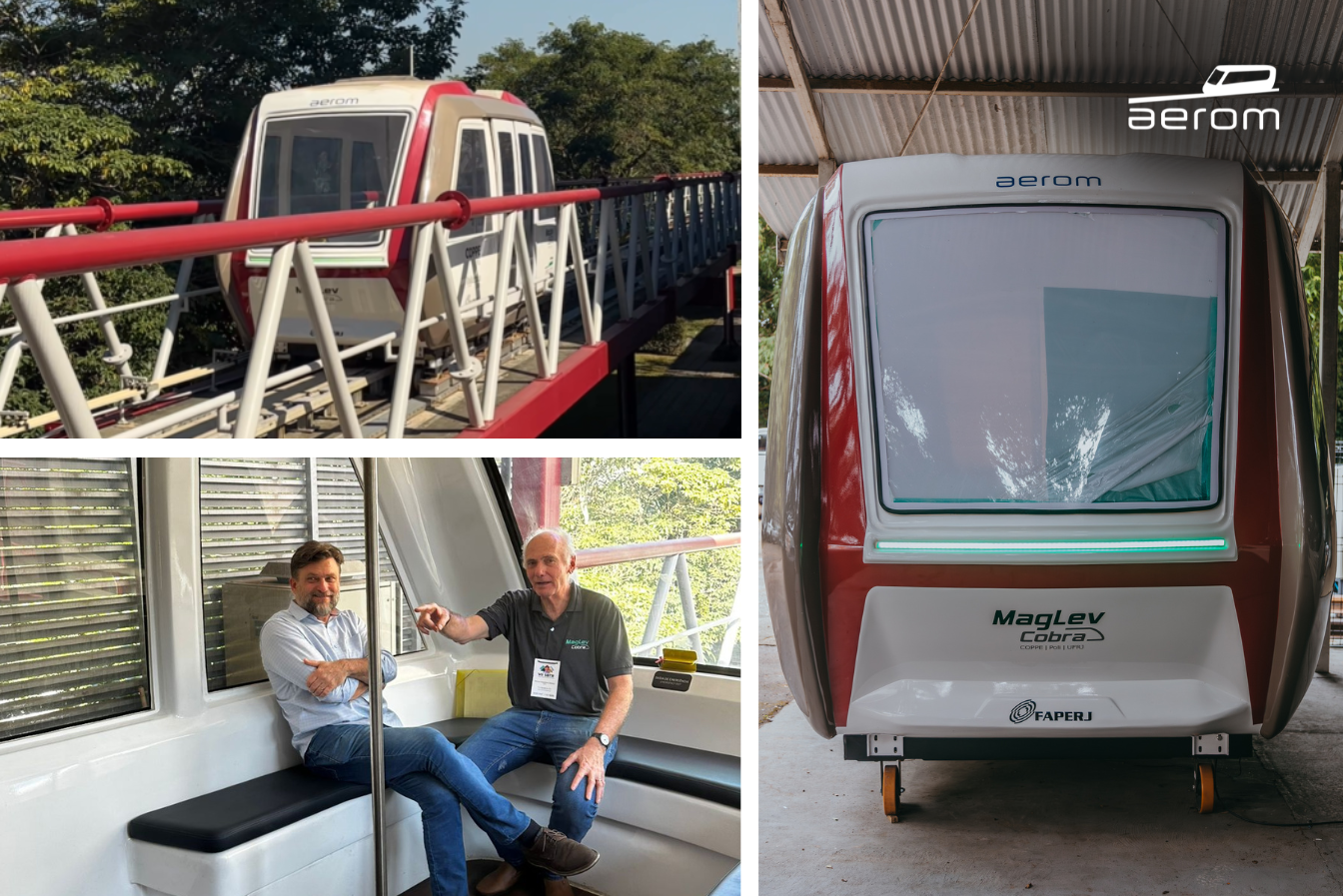
Developed by UFRJ, MagLev-Cobra is an urban transit system based on superconducting magnetic levitation, designed to provide an energy-efficient, low-emission alternative for medium-capacity public transportation. The project is coordinated by Dr. Richard Stephan, Professor of Electrical Engineering at UFRJ, with financial support from the Rio de Janeiro State Research Foundation (FAPERJ).
Aerom has been involved in the project’s development for several years. Through previous collaboration with COPPE/UFRJ, the company developed a new vehicle and the system’s control architecture, contributing to the evolution of the experimental platform currently operating on the university campus.
Advancing superconducting magnetic levitation
MagLev-Cobra combines high-temperature superconductors with rare-earth permanent magnets to achieve magnetic levitation without mechanical contact between the vehicle and the guideway. By eliminating wheel-to-rail friction, the technology has the potential to reduce maintenance requirements, improve energy efficiency and significantly lower operational noise.
The system is designed to operate on elevated guideways at speeds exceeding 70 km/h, negotiate curves with radii of approximately 50 meters and climb gradients of up to 15%, characteristics that provide greater flexibility for urban deployment.
Project studies also indicate that infrastructure costs can be substantially lower than those of conventional metro systems while remaining competitive with modern light rail transit solutions.
Today, MagLev-Cobra operates on a 200-meter demonstration line connecting two technology centers at UFRJ, where the platform continues to serve as a testbed for research, validation and technological advancement.
From research to real-world applications
Under the licensing agreement, Aerom will support the continued technological development of the MagLev-Cobra platform while pursuing future commercial opportunities in Brazil and international markets.
The agreement reinforces the role of collaboration between academia and industry in accelerating the transition of emerging technologies from research laboratories to practical transportation solutions.
Complementary technologies for sustainable mobility
Although based on different engineering principles, MagLev-Cobra and Aeromovel share a common objective: delivering innovative, energy-efficient and sustainable public transportation systems.
Aeromovel employs pneumatic propulsion technology that has already been validated in commercial operation, while MagLev-Cobra represents a new generation of superconducting magnetic levitation systems currently advancing toward commercial readiness.
By adding MagLev-Cobra to its technology portfolio, Aerom broadens its ability to deliver mobility solutions tailored to different operational requirements, strengthening the company’s position as a developer of advanced transportation technologies and reinforcing its commitment to innovation in sustainable urban mobility.
READ MORE:
Marcus Coester Joins SemiCon-LAC 2026 as Panelist in Porto Alegre
German Engineering Students Visit the Aeromovel System in Guarulhos